Posts

Free Tutorial : GIS

Image
Founding and Honorary Editor Innovate for Sustainability Subscribe to this blog Publish your book with EIS Publishers Instructor of Self Paced Course on Six-week course on Introduction to Remote Sensing and GIS Sponsored by Ashwagandha and Other Products for Enhancing Immunity.. Nutrilite(Use 13238584 as ABO ID) Procure Hydrology Themed T-Shirts from Innovate S Returns from commissions donated to NGOs after deducting the cost of honorarium and maintenance.

Free Tutorial : Artificial Intelligence in Water Resources

Image
Founding and Honorary Editor Innovate for Sustainability Subscribe to this blog Publish your book with EIS Publishers Instructor of Self Paced Course on Six-week course on Introduction to Remote Sensing and GIS Sponsored by Ashwagandha and Other Products for Enhancing Immunity.. Nutrilite(Use 13238584 as ABO ID) Procure Hydrology Themed T-Shirts from Innovate S Returns from commissions donated to NGOs after deducting the cost of honorarium and maintenance.

Artificial Neural Network for Beginners

Image
Founding and Honorary Editor Innovate for Sustainability Subscribe to this blog Publish your book with EIS Publishers Instructor of Self Paced Course on Six-week course on Introduction to Remote Sensing and GIS Sponsored by Ashwagandha and Other Products for Enhancing Immunity.. Nutrilite(Use 13238584 as ABO ID) Procure Hydrology Themed T-Shirts from Innovate S Returns from commissions donated to NGOs after deducting the cost of honorarium and maintenance.

Lecture on Grey Wolf Optimization(GWO)

Image
Founding and Honorary Editor Innovate for Sustainability Subscribe to this blog Publish your book with EIS Publishers Instructor of Self Paced Course on Six-week course on Introduction to Remote Sensing and GIS Sponsored by Ashwagandha and Other Products for Enhancing Immunity.. Nutrilite(Use 13238584 as ABO ID) Procure Hydrology Themed T-Shirts from Innovate S Returns from commissions donated to NGOs after deducting the cost of honorarium and maintenance.

Lecture on Mine Burst Algorithm

Image
Lecture on MBA a metaheuristic algorithm which follows the bursting of mines in a minefield. The lecture is designed as per the following content but may not be limited to the same : I. Introduction  - Explanation of Mine Burst Algorithm  - Importance of Mine Burst Algorithm in data mining  - Purpose of the lecture II. Overview of Mine Burst Algorithm  - Description of how Mine Burst Algorithm works  - Comparison with other data mining algorithms  - Advantages of using Mine Burst Algorithm III. Implementation of Mine Burst Algorithm  - Steps involved in implementing Mine Burst Algorithm  - Tools and software required for implementation  - Examples of real-life applications using Mine Burst Algorithm Founding and Honorary Editor Innovate for Sustainability Subscribe to this blog Publish your book with EIS Publishers Instructor of Self Paced Course on Six-week course on Introduction to Remote Sensing and GIS Sponsored by Ashwagandha and Other Products for Enhancing Immunity.. Nutrilit...

Introduction to Ant Colony Optimization

Image
Ant Colony Optimization or ACO in short is now widely used as an optimization technique for discrete optimization problems. This algorithm mimicks the food foraging behaviour of an Ant Colony. Ant Colony Optimization is a powerful tool in problem-solving due to its ability to find near-optimal solutions in complex, dynamic environments. By leveraging the principles of swarm intelligence, this algorithm can effectively tackle a wide range of optimization problems with multiple variables and constraints. For example, in the field of logistics, Ant Colony Optimization has been successfully applied to vehicle routing problems, where the goal is to find the most efficient routes for multiple vehicles by mimicking how ants communicate and coordinate with each other to efficiently explore and exploit different routes. This can ultimately lead to cost savings and faster delivery times. Ant Colony optimisation is a powerful tool in problem-solving due to its ability to find near-optimal solutio...

Introduction to Galactic Swarm Optimization

Image
Galactic Swarm Optimization (GSO) is a metaheuristic algorithm inspired by the behavior of space swarms. It combines gravitational force and swarm intelligence concepts to solve optimization problems in various fields.  GSO has been proven effective in solving optimization problems involving high-dimensional search spaces, non-linear relationships, and unsupervised classification problems. By utilizing collective intelligence and decentralized decision-making, GSO can efficiently explore the solution space and converge towards the global optimum. This makes it an important tool for addressing real-world problems in fields such as engineering, finance, and logistics.  In this video, we will delve deeper into the principles behind GSO and explore its applications in various domains. Founding and Honorary Editor  @Mrinmoy Founding and Honorary Editor of HydroGeek https://www.mrinmoy.majumdar.info/ X  /  Insta  /  YouTube  /  LinkedIn  /...

Particle Swarm Optimization with out code

Image
Definition of Particle Swarm Optimization (PSO) Particle Swarm Optimization (PSO) is a population-based stochastic optimization technique inspired by the social behavior of birds flocking or fish schooling. In PSO, a group of candidate solutions, called particles, move around the search space to find the optimal solution through cooperation and communication. Brief history of PSO PSO was first introduced by Kennedy and Eberhart in 1995 as a way to optimize continuous nonlinear functions. Since then, it has been widely used in various fields such as engineering, economics, and biology for solving complex optimization problems. Importance of PSO in optimization problems PSO has proven to be effective in finding solutions to problems with high-dimensional search spaces and non-linear constraints. Its ability to quickly converge to near-optimal solutions makes it a valuable tool for researchers and practitioners facing complex optimization challenges. PSO's ability to efficiently explo...

Introduction to Moth Flame Optimization Techniques

Image
 The Moth Flame Optimization algorithm was first introduced in 2015 by Seyedali Mirjalili as a nature-inspired metaheuristic algorithm based on the behavior of moths seeking light sources in the dark.  This algorithm has shown promising results in solving complex optimization problems and has been compared favorably with other popular optimization algorithms such as Genetic Algorithms and Particle Swarm Optimization.  In various fields such as engineering, finance, and biology, MFO has been successfully applied to optimize parameters, design structures, and solve real-world problems efficiently.  One key advantage of the Moth Flame Optimization algorithm is its ability to quickly converge to the global optimum solution, making it a valuable tool for researchers and practitioners alike.  Additionally, MFO is known for its simplicity and ease of implementation, making it accessible to a wide range of users with varying levels of expertise in optimization technique...

Dynamic Soaring of Albatrosses Optimization Technique

Image
The concept of dynamic soaring by Albatrosses, a large seabird, can be used in optimization by flying long distances without using their muscles. This flight pattern, similar to riding a sidewinding rollercoaster, can fly up to 10,000 miles in a single journey and circumnavigate the earth in 46 days. Dynamic soaring consists of four phases: upward bend, upward climb, downward bend, and downward dive. Criteria for dynamic soaring include no wind, no waves, wave-slope soaring in swell without wind, and wind-shear soaring in wind without waves. Founding and Honorary Editor Innovate for Sustainability Subscribe to this blog Publish your book with EIS Publishers Instructor of Self Paced Course on Six-week course on Introduction to Remote Sensing and GIS Sponsored by Ashwagandha and Other Products for Enhancing Immunity.. Nutrilite(Use 13238584 as ABO ID) Procure Hydrology Themed T-Shirts from Innovate S Returns from commissions donated to NGOs after deducting the cost of honorarium and ...

Cat Swarm Optimization Techniques

Image
Techniques known as "Cat Swarm Optimisation" (CSO) are based on an optimisation algorithm inspired by nature and the collective behaviour of cats. CSO mimics the cooperation and communication among a group of cats to tackle complex optimisation issues. It is inspired by the hunting behaviour and social interactions of cats. These methods' capacity to efficiently explore broad search spaces and identify ideal answers has drawn a lot of attention in recent years.  The capacity of CSO approaches to manage high-dimensional and non-linear optimisation issues is one of its main benefits. Because of this, they can be used in a variety of industries and domains, including data mining, engineering, and finance. Furthermore, CSO algorithms are renowned for their resilience and capacity to function in unpredictable and noisy conditions.  Founding and Honorary Editor Innovate for Sustainability Subscribe to this blog Publish your book with EIS Publishers Instructor of Self Paced Co...

Introduction to Invasive Weed Optimization Technniques

Image
The Invasive Weed Optimization Technique (IWOT) is a metaheuristic algorithm inspired by the invasive growth patterns of weeds in nature. This algorithm was first introduced by Mehrabian and Lucas in 2006 as a novel approach to solving complex optimization problems. IWOT aims to mimic the competitive and adaptive behavior of weeds, which allows them to efficiently colonize new areas and survive in harsh environments. By emulating this natural phenomenon, IWOT has proven to be highly effective in finding optimal solutions for a wide range of problems across various fields.  The origin of IWOT can be traced back to the study of biological systems and their ability to adapt and thrive in challenging conditions. The development of this technique involved extensive research and experimentation to understand the underlying principles of weed growth and apply them to optimization problems. Over time, IWOT has evolved and been refined through the integration of mathematical models and comp...

Risk Minimization of Wetlands from Climatic Vulnerabilities by Firefly and Glowworm Optimization Techniques

Image
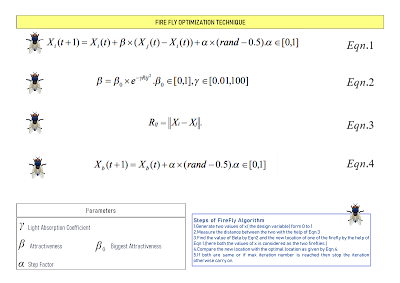
Definition and a brief explanation of the Fire Fly Algorithm The Fire Fly Algorithm (FFA) is a nature-inspired metaheuristic optimization algorithm that is based on the behavior of fireflies. It was first introduced by Xin-She Yang in 2008. Similar to other swarm intelligence algorithms, FFA imitates the collective behavior of fireflies to solve complex optimization problems. Fireflies communicate with each other through the emission of light, which is used to attract mates or find food sources. In FFA, this behavior is translated into a mathematical model where Overview of its applications in optimization problems FFA has been successfully applied to various optimization problems, including but not limited to, engineering design, image processing, data clustering, and economic modeling. It has shown promising results in finding optimal solutions for these problems by efficiently exploring the search space and exploiting the collective intelligence of the swarm. Additionally, FFA's...

Call for Internship of Water,Energy and Metaheuristics

Optimal Water Allocation in Thermal Power Plant with the help of Mine Bursting Algorithm and Glowworm Optimization Algorithm: How to achieve this objective?  Launching this today(19/10/2023) at 11 AM at YouTube : https://youtu.be/nBi16qrKmMY Founding and Honorary Editor Innovate for Sustainability Subscribe to this blog Publish your book with EIS Publishers Instructor of Self Paced Course on Six-week course on Introduction to Remote Sensing and GIS Sponsored by Ashwagandha and Other Products for Enhancing Immunity.. Nutrilite(Use 13238584 as ABO ID) Procure Hydrology Themed T-Shirts from Innovate S Returns from commissions donated to NGOs after deducting the cost of honorarium and maintenance.

Brief Introduction to Genetic Algorithm

Definition of Genetic Algorithm A genetic algorithm is a type of optimization algorithm inspired by the process of natural selection. It is used to find optimal solutions to complex problems by mimicking the process of evolution through selection, crossover, and mutation. Brief history of Genetic Algorithm The concept of genetic algorithms was first introduced by John Holland in the 1960s, and since then, they have been widely applied in various fields such as engineering, computer science, and biology. They have proven to be effective in solving problems that are difficult to tackle using traditional methods. Importance of Genetic Algorithm in artificial intelligence and optimization Genetic algorithms play a crucial role in artificial intelligence and optimization by providing a powerful tool for finding solutions in complex, dynamic environments. Their ability to adapt and evolve makes them particularly valuable in tasks such as machine learning, data mining, and optimization proble...